
The Seven Dimensions of Team Learning
Turner et al.’s (2020) systematic review synthesized the full range of team learning definitional components into seven dimensions. These dimensions collectively represent the process layer of team learning — the behaviors and orientations that, when enacted, produce learning outcomes.
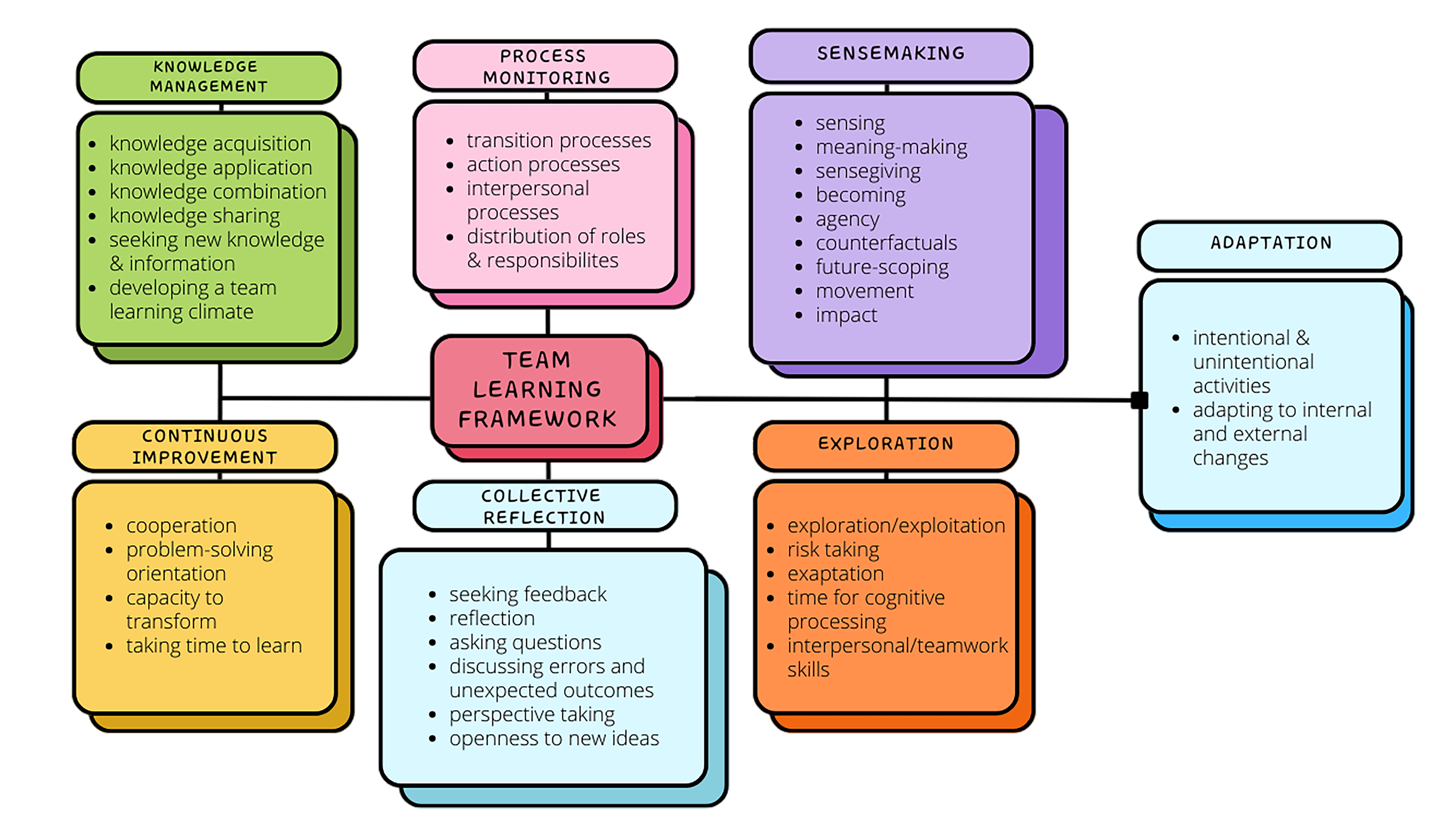
1. Knowledge Management (KM)
Activities for capturing, sharing, combining, and applying knowledge within the team. In science teams, KM includes maintaining shared databases, documentation practices, cross-training, and structured knowledge transfer across project phases.
Associated behaviors: knowledge acquisition, application, combination, and sharing; seeking new information and knowledge relevant to the team’s tasks.
2. Process Monitoring (PM)
Ongoing tracking of the team’s progress toward goals and the quality of its processes. Drawing on Marks et al. (2001), teams cycle through transition phases (mission analysis, planning), action phases (monitoring progress, coordination), and interpersonal phases (conflict management, motivation).
Associated behaviors: team monitoring of goal achievement; ensuring shared outcomes among members are achieved.
3. Sensemaking (SM)
The process of collectively interpreting and making meaning from complex, ambiguous, or unexpected events. Senge (2006) frames sensemaking as requiring team members to identify patterns not only in the external environment but within their own team processes.
Associated behaviors: action guided by sensemaking characteristics; team member interaction that generates shared interpretation.
4. Adaptation (AD)
The intentional or unintentional activities team members apply to address perturbations — changes external or internal to the team. Adaptation is a necessary precondition for innovation, and must be in advance of unexpected threats to be beneficial (Weick & Quinn, 1999).
Associated behaviors: adapting to internal and external changes; becoming the foundation for emergence and new patterns of behavior.
5. Exploration (EX)
Applying team members’ KSA to test new ideas, methods, and potential solutions — as distinct from simply exploiting existing capabilities. Science teams, by nature, exist on the exploratory end of this spectrum, but must deliberately maintain both orientations.
Associated behaviors: experimentation, risk-taking, openness to new ideas.
6. Collective Reflection (CR)
Jointly examining the team’s assumptions, processes, errors, feedback, and unexpected outcomes, and using these reflections to update understanding and practice. Torraco (2002) describes the iterative cycle: purposeful actions, discovered consequences, implications, reassessments, and further actions.
Associated behaviors: feedback-seeking, error discussion, questioning assumptions, perspective-taking.
7. Continuous Improvement (CI)
The ongoing commitment to improving team processes, capabilities, and outcomes over time — sustained by a psychologically safe environment. Edmondson (1999; 2019) identifies psychological safety as the enabling condition: team members must feel safe enough to be candid, to surface problems, share imperfect ideas, and admit mistakes without fear.
Associated behaviors: changes to improve team processes; ongoing improvement of team members’ skills and the team’s collective capability.
The Seven Dimensions at a Glance
| Dimension | Abbreviation | Core Question |
|---|---|---|
| Knowledge Management | KM | Are we capturing, sharing, and applying what we know? |
| Process Monitoring | PM | Are we tracking our progress and coordinating effectively? |
| Sensemaking | SM | Are we making sense of our environment and our own processes? |
| Adaptation | AD | Are we responding and adjusting to changes? |
| Exploration | EX | Are we testing new ideas and taking well-conceived risks? |
| Collective Reflection | CR | Are we examining our assumptions, errors, and feedback together? |
| Continuous Improvement | CI | Are we using what we learn to get better over time? |
See Also
References
Edmondson, A. (1999). Psychological safety and learning behavior in work teams. Administrative Science Quarterly, 44, 350–383. https://doi.org/10.2307/2666999
Edmondson, A. C. (2019). The fearless organization: Creating psychological safety in the workplace for learning, innovation, and growth. Wiley.
Liebowitz, J. (2003). A knowledge management strategy for the Jason organization: A case study. The Journal of Computer Information Systems, 44(2), 1–5. https://www.tandfonline.com/journals/ucis20
Marks, M. A., Mathieu, J. E., & Zaccaro, S. J. (2001). A temporally based framework and taxonomy of team processes. Academy of Management Review, 26(3), 356–376. https://doi.org/10.5465/AMR.2001.4845785
Raisch, S., & Birkinshaw, J. (2008). Organizational ambidexterity: Antecedents, outcomes, and moderators. Journal of Management, 34(3), 375–409. https://doi.org/10.1177/0149206308316058
Senge, P. M. (2006). The fifth discipline: The art & practice of the learning organization. Currency Doubleday.
Torraco, R. J. (2002). Cognitive demands of new technologies and the implications for learning theory. Human Resource Development Review, 1(4), 439–467. https://doi.org/10.1177/1534484302238436
Turner, J. R., Allen, J., Hawamdeh, S., & Mastanamma, G. (2023). The multifaceted sensemaking theory: A systematic literature review and content analysis on sensemaking. Systems, 11(3), 24. https://doi.org/10.3390/systems11030145
Turner, J. R., Thurlow, N., & Rivera, B. (2020). The flow system: The evolution of agile and lean thinking in an age of complexity. Aquiline Books–UNT.
Wang, G. G., & Wang, J. (2004). Toward a theory of human resource development learning participation. Human Resource Development Review, 3(4), 326–353. https://doi.org/10.1177/1534484304271152
Weick, K. E., & Quinn, R. E. (1999). Organizational change and development. Annual Review of Psychology, 50, 361–386. https://doi.org/10.1146/annurev.psych.50.1.361