
A Brief History of Team Modeling
The scientific study of teams has evolved through several distinct phases of model development.
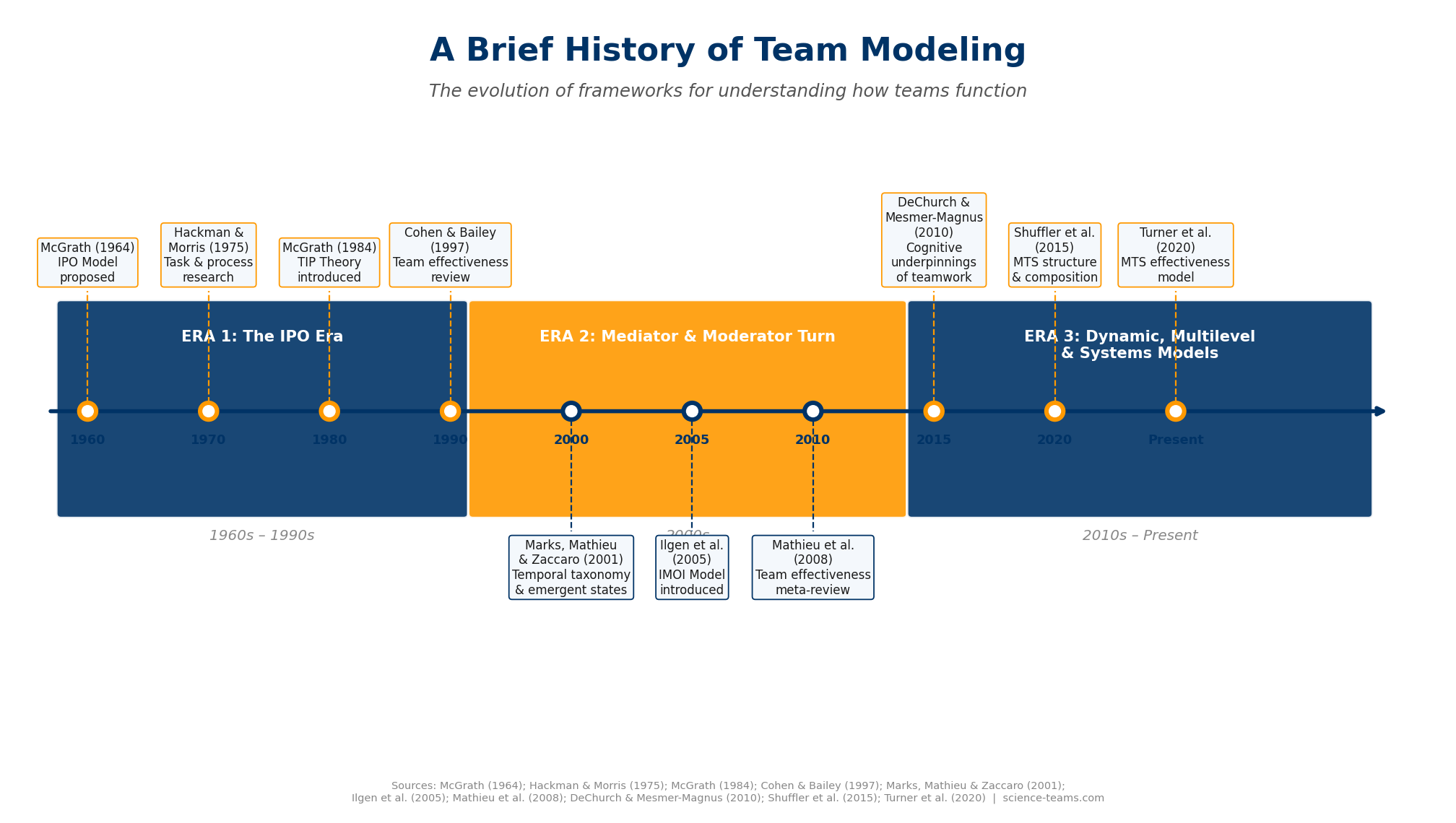
1960s–1990s — The IPO Era
The dominant framework emerging from McGrath (1964) was the Input-Process-Output (IPO) model, which provided a clean, causal logic: inputs shape processes, processes shape outcomes. This framework drove decades of team research and remains widely used today.
2000s — The Mediator and Moderator Turn
Researchers recognized that the IPO model was too linear and too static. Ilgen et al. (2005) proposed the IMOI model (Input-Mediator-Output-Input), acknowledging that team outcomes feed back into subsequent inputs, making team functioning cyclical rather than one-directional. Emergent states — motivational, affective, and cognitive phenomena that arise from team interactions — were distinguished from behavioral processes.
2010s–Present — Dynamic, Multilevel, and Systems Models
The frontier of team modeling has moved toward multilevel, dynamic, and systems-theoretic frameworks. These models acknowledge that team learning and performance emerge from individual-level cognitions, are shaped by team-level interactions, and are institutionalized across organizational levels — all simultaneously.
References
Ilgen, D. R., Hollenbeck, J. R., Johnson, M., & Jundt, D. (2005). Teams in organizations: From input-process-output models to IMOI models. Annual Review of Psychology, 56(1), 517–543. https://doi.org/10.1146/annurev.psych.56.091103.070250
McGrath, J. E. (1964). Social psychology: A brief introduction. Holt, Rinehart & Winston.